Creation begins at the place where explanation ends.
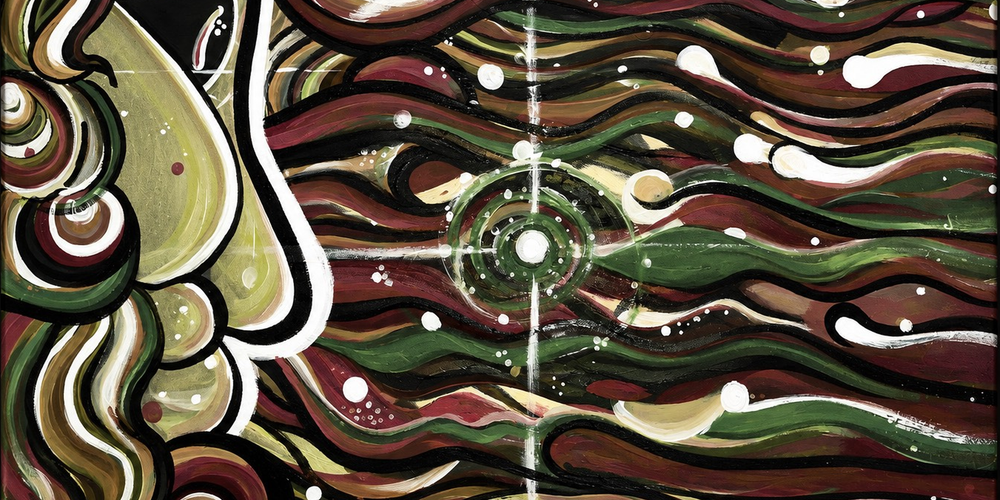
Streams of deep green, burgundy, black, earth tones, and white move across the composition like currents of matter and energy suspended in an undefined universe. What initially appears chaotic gradually reveals structure, with movement converging toward a luminous point near the center.
That center can become many things depending upon the viewer. An atom. A cell. A star. An embryo. An eye. Perhaps even the first concentration of matter in an emerging universe.
The intersecting white lines give the central form the appearance of a coordinate, as though an exact point has suddenly been established within something previously without boundaries. Organic forms emerge from the surrounding movement, suggesting the progression from energy into matter, and ultimately from matter into life.
Creation is less concerned with answering how existence began than with confronting the extraordinary fact that it did.
Science searches for the mechanism. Religion searches for the creator. Philosophy asks what existed before either could be understood. Creation occupies the space between those questions, the unknowable instant when there was possibility, and then there was something.